Clinincally reviewed and contributed to by Alise Lindsey, LPC, LMHC, CCTP. Published October 15, 2025.
Healthy communication is part of any relationship, however what makes communication healthy and impactful? Couples talk all the time, but it's vital to connect in a meaningful way. If conversations with your partner rarely go beyond “How was your day?” you're not alone. Most couples fall into familiar communication habits that work for the day-to-day but don’t always support deeper emotional connection.
That’s where relationship check-ins come in.
A relationship check-in is a dedicated time to slow down, get curious about each other, and talk about things that really matter. This guide walks you through everything you need: why check-ins help, how to set the tone, and the best relationship check-in questions to deepen your connection with your partner.
Let’s start with the basics.

Why Do Relationship Check-Ins Matter?
Strong relationships are built on healthy, meaningful and consistent communication. Meaningful conversations occur when couples intentionally and actively listen and express themselves. They happen when you make space for them.
Relationship check-ins help couples:
- Strengthen emotional intimacy through shared vulnerability
- Address small issues before they snowball into bigger ones
- Build a habit of intentional communication
- Reconnect after periods of stress or distance
Research from the Gottman Institute shows that couples who regularly “turn toward” each other during moments of need build more trust and resilience over time. In other words, little moments of connection add up.
Relationship check-ins aren’t about fixing something that’s broken. They’re about caring for your relationship the way you’d care for your health. Not because something’s wrong, but because it matters.
Takeaway: Just like brushing your teeth and seeing the dentist, regular check-ins are a form of maintenance. They keep the emotional foundation of your relationship strong.

How Do You Create a Safe Space for Honest Check-Ins?
A good check-in isn’t just about the questions you ask. It’s about how you ask them and the space you create together.
Here’s how to set the tone:
- Choose a time when you’re both calm and available. Avoid jumping into a check-in during a heated moment, after a long work day, before a social event or when one of you is distracted.
- Put away phones and other screens. Giving each other full attention is part of what makes the conversation meaningful.
- Keep your tone light and curious. You’re not conducting an interview or a performance review.
- Make emotional safety the goal. That means no interruptions, no judgments, and no rushing to solve problems.
- Schedule something to connect after. Having a fun interaction planned after your check-in can help you remember that two things can be true at once; you can have a difficult discussion and still love and be close to your partner.
Takeaway: You can’t force connection, but you can create the right conditions for it. The more emotionally safe the space feels, the more honest your check-in will be.
What Are the Best Relationship Check-In Questions?
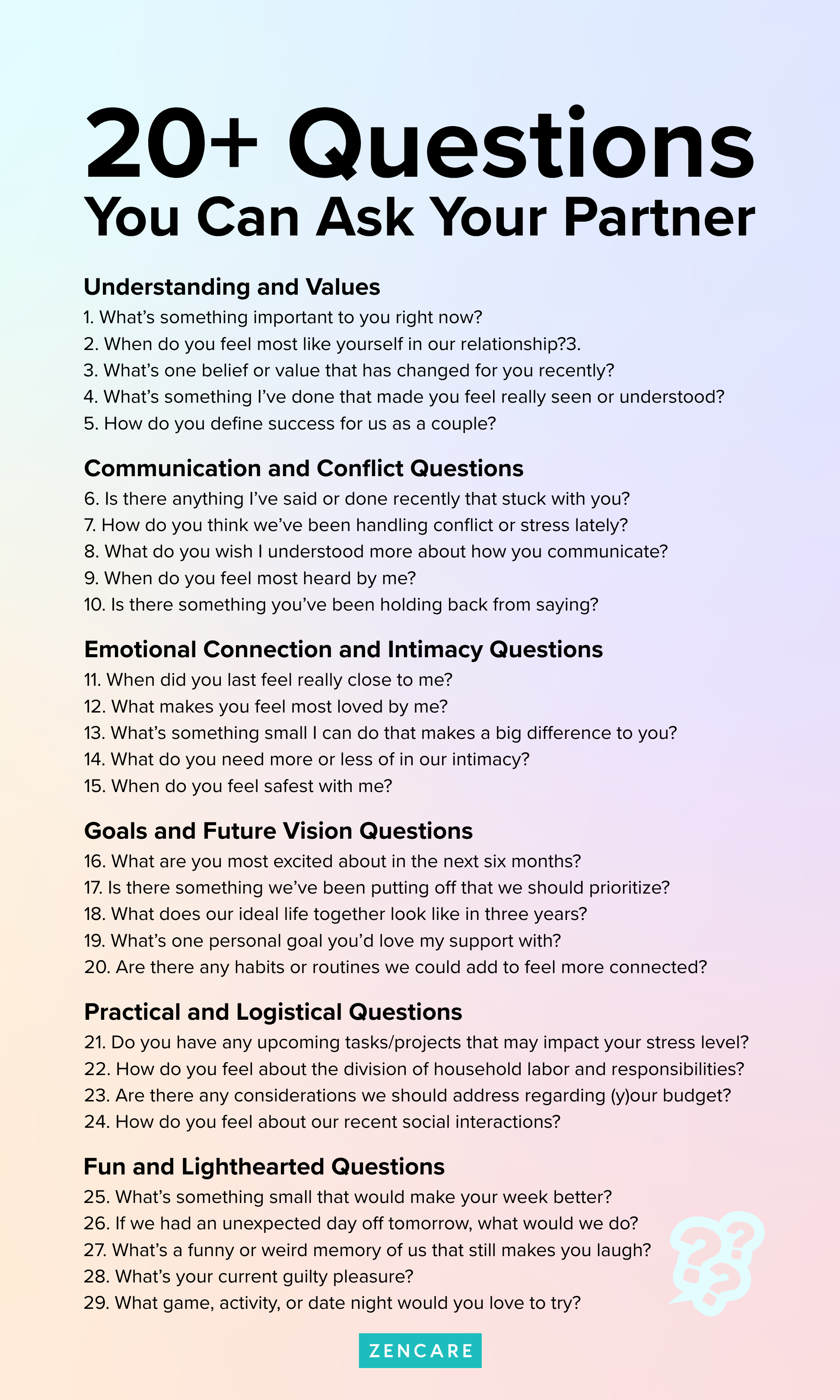
Here’s the heart of it: the questions. These prompts are designed to help you understand each other more deeply, strengthen communication, and reconnect emotionally.
We’ve grouped the questions by theme so you can choose the ones that feel right for where you are.
Understanding and Values Questions
These questions help you get to know your partner’s inner world. People grow and change. Values and desires change. These conversations help you stay in sync.
- What’s something important to you right now?
- When do you feel most like yourself in our relationship?
- What’s one belief or value that has changed for you recently?
- What’s something I’ve done that made you feel really seen or understood?
- How do you define success for us as a couple?
Tip: These questions are especially powerful during periods of change or personal growth.
Communication and Conflict Questions
Want to improve how you handle stress, disagreements, or misunderstandings? Start with how you communicate.
- Is there anything I’ve said or done recently that stuck with you, in a good or bad way?
- How do you think we’ve been handling conflict or stress lately?
- What do you wish I understood more about how you communicate?
- When do you feel most heard by me?
- Is there something you’ve been holding back from saying?
Tip: Stay open and listen with curiosity, not defensiveness.
Emotional Connection and Intimacy Questions
These questions are about closeness, trust, and love. Ask them when you want to feel more emotionally or physically connected.
- When did you last feel really close to me?
- What makes you feel most loved by me?
- What’s something small I can do that makes a big difference to you?
- What do you need more or less of in our intimacy?
- When do you feel safest with me?
Tip: Make space for vulnerability. These questions invite real closeness.
Goals and Future Vision Questions
Check-ins are a great time to explore whether you’re on the same page about the future.
- What are you most excited about in the next six months?
- Is there something we’ve been putting off that we should prioritize?
- What does our ideal life together look like in three years?
- What’s one personal goal you’d love my support with?
- Are there any habits or routines we could add to feel more connected?
Tip: These are perfect for monthly or quarterly check-ins, especially during life transitions.
Practical and Logistical Questions
These questions address the day to day events that might affect stress.
- Do you have any upcoming tasks/projects that may impact your stress level?
- How do you feel about the division of labor regarding household tasks and responsibilities?
- Are there any considerations we should address regarding (y)our budget?
- How do you feel about our recent social interactions?
Tip: Use these questions during weekly or biweekly check-ins to stay on top of everyday stressors and prevent small frustrations from building up.
Fun and Lighthearted Questions
Don’t underestimate the power of laughter and play. These questions help keep things fun and easy.
- What’s something small that would make your week better?
- If we had an unexpected day off tomorrow, what would we do?
- What’s a funny or weird memory of us that still makes you laugh?
- What’s your current guilty pleasure?
- What game, activity, or date night would you love to try?
Tip: Use these to break the ice or close a check-in on a high note.
Takeaway: Mix up the themes. A little reflection, a little fun, and a lot of honesty go a long way.
How Often Should Couples Do Relationship Check-Ins?
The best check-in schedule is the one you’ll actually stick with. There’s no magic number, but here are a few options to consider.
- A weekly 15-minute check-in. Keep it short and simple. Choose a few questions and make it part of your Friday evening routine.
- A monthly date-night deep dive. This gives you more time to reflect, plan, and dream together.
- Seasonal sync-ups. These are helpful during transitions like moving, starting a new job, or having a baby.
- As-needed check-ins. When something feels off, talk about it before it turns into something bigger.
What matters most is consistency. Build the habit in a way that feels natural for both of you. That way asking and answering some of these questions doesn’t ever feel like out of left field for either of you, or like one partner is “attacking” the other.
Takeaway: Frequency doesn’t matter as much as regularity. Find a rhythm that works and protect that time together.
What Is Active Listening and Why Does It Matter?
A good question can only go so far if it’s not matched by good listening. Couple's who approach check-ins, and any other discussion with their partner, with an open mind and the belief that it’s you against the problem rather than you against one another — are likely to see success.
Focus on hearing and understanding the problem and your partners’ needs and/or proposed solution rather than becoming defensive.
Here’s how to practice it:
- Don’t interrupt. Let your partner finish their thought before responding.
- Reflect back what you heard. Try something like, “So it sounds like you’re feeling…”
- Validate their feelings first. Even if you see things differently, you can still acknowledge their experience.
- Pause before replying. Give yourself a second to respond thoughtfully instead of reactively.
- Use your body language. Nod, make eye contact, face your partner and show that you’re engaged.
Often, your partner doesn’t need a solution. They just want to feel heard. You can also plainly ask, “would you like a solution or support?” Sometimes we’re so quick to want to fix a problem, we don’t focus on the person in front of us.
Takeaway: Listening well is one of the most powerful tools for deepening connection with your partner. It’s not about solving. It’s about understanding.
How Do You Turn Conversation Into Action?
Talking is important, but it’s the follow-through that builds trust. To increase the likelihood of success, ensure you have realistic and clear expectations on action items. Don’t agree to things you are unwilling or unable to do, but keep in mind the goal is to compromise and grow which means stepping out of your comfort zone.
You don’t have to be perfect, but you need to make consistent effort. If you find yourself easily becoming defensive, frustrated with yourself and/or your partner or giving up, you may consider your own therapy for emotional regulation.
Once you’ve had a check-in, look for ways to apply what you’ve learned.
- Notice patterns. If the same need keeps coming up, talk about how to meet it together.
- Brainstorm small actions. It might be more hugs, fewer screens during dinner, or leaving encouraging notes.
- Write things down. Create a shared note on your phone or keep a notebook of ideas and goals.
- Review your progress. Celebrate what’s working, and adjust what isn’t. Cheers to it all over dinner!
- Keep showing up. Even small shifts can bring you closer over time, nothing happens overnight.
Takeaway: Insight creates clarity. Action creates connection. Let your conversations lead to small but meaningful change.
Conclusion: The Strongest Relationships Are Built One Question at a Time
Relationship check-ins aren’t a sign that something’s wrong. They’re a sign that you care enough to stay connected, curious, and close.
You don’t need to do everything at once. Start with just a few questions. Be consistent. Keep the space safe. And let these conversations deepen your understanding of each other.
Here are three questions you can try tonight:
- What’s something important to you right now that I might not fully understand?
- When did you last feel really close to me?
- If we had an unexpected day off tomorrow, what would we do?
Keep the list handy. Save it to your phone. Post it on your fridge. Use it whenever you want to check in and reconnect.
FAQs About Relationship Check-Ins, Answered by Alise Lindsey, LPC, LMHC, CCTP
What is a relationship check-in?
A relationship check-in is a planned, consistent, opportunity to discuss how partners feel and what they may need in their relationship. Check-ins allow for nurturing fondness and admiration by pointing out growth and adherence to goals. Consistently engaging in check-ins decreases discord and increases healthy communication and connection.
How often should we do a relationship check-in?
Short check-in’s should be done at least biweekly and at least monthly for a more in depth discussion. Ultimately, it’s best to do what you can maintain.
What kinds of questions should we ask?
Aim for open ended questions regarding important themes for a healthy relationship; trust, communication, finances, intimacy, stress etc.
What if my partner doesn’t want to do check-ins?
Relationship check-ins may not work best for every couple. It’s important that you are in agreement on how you will address and maintain open communication regarding the various aspects of your relationship.
How do I know if our check-ins are helping?
Set goals and follow up on them in the check-ins. Pay attention to how you feel about communication during and outside of check-ins. These are indicators that your consistency is paying off.